Media Discourse on Sexuality in Lebanon

In 2012, Lebanon experienced some kind of change in the media’s representation of sexuality. It all started when a TV show by the name “Enta Horr” aired on MTV Lebanon. The show displayed “videos secretly shot in abandoned cinema houses, showing men engaging in sexual acts and viewing pornographic material.” (Mandour, 2013).

As a result, police raided the cinemas and started arresting those involved, who “were forced to undergo the “anal test” – considered an act of rape by Lebanese civil activist groups […]” (Mandour, 2013).

Since then, many organizations and groups have been adopting different arguments regarding homosexuality and how it must be showcased in the media. Eventually, this movement “suggested a reformulation of attitude from taboo-ing homosexuality to
taboo-ing homophobia.” (Mandour, 2013).

In April, 2013 police raided a gay night club in Beirut called GHOST:

Three allegedly homosexual men and a transsexual woman were arrested, harassed verbally and physically, forced to strip naked, photographed, shamed, violently beaten, and forced to simulate intimate acts […].

Mandour, 2013

Ever since, people’s eyes have been opened towards the topic of sexuality, which led to the emergence of numerous progressive initiatives that are fighting to be heard on media platforms, advocating for LGBT rights and freedom.

Reference List

Mandour, S. (2013). Potential Change in Media Discourse on Sexuality in Lebanon:
“Cinema Plaza” and Beyond. University of Oxford.

Patriarchy in Arab Media

As cited by Zaatari (2014),  patriarchy is ‘the system of male dominance’ (Mumford, 1995). This system is inclusive of social, political, and cultural aspects. The media in the Arab world has played a role in supporting such patriarchal systems, constantly under or misrepresenting women in news stories and other media content.

I can clearly remember bonding with my family in front of the TV over “Bab El-Hara” after Iftar. The Syrian show has succeeded to bring many people, like my family, together; reminding them of simpler, happier times. However, as much nostalgia one feels looking back, there is no denying that that the show conveyed a first-hand patriarchal system.

“The show reflects a time where women have almost no access to the public space-except through a male chaperone, have no decision-making power in family affairs-including their marriage and divorce, and are expected to accept their husbands’, fathers’, brothers’, and sons’ wishes and anger.”

Zaatari, 2014

Other than TV shows similar to Bab El-Hara, different media platforms did a great job in reinforcing ideas of patriarchy, femininity, and masculinity. For example, studies have shown that Palestinian women’s active role in resisting occupation has been highly underrepresented in the media, and the numbers are there to prove it (TAM, 2017). Both men and women of Palestine have unarguably struggled with the Israeli occupation, but it seems as though the way women’s suffering is portrayed in the media is somewhat marginalized.

“They are being presented as weak and victims; being symbolized only by their tender and humane traits rather than focusing on their skills, capacities, knowledge and experiences.”

TAM, 2017

Reference List

Zaatari, Z. (2014). Desirable Masculinity/Femininity and Nostalgia of the “Anti-Modern”: Bab el-Hara Television Series as a Site of Production. Sexuality & Culture, 19(1), 16–36. doi: 10.1007/s12119-014-9242-5

Media Monitoring of Palestinian women’s image and representation in
news related to peace and security. (2017). Women Media and Development (TAM). Bethlehem, West Bank – Palestine.

How the Film “Forrest Gump” Portrays Disability

If I were to classify the kind of stereotype about the disabled in Robert Zemeckis’ “Forrest Gump” according to Barnes’ list, I believe it would fall under “The Disabled Person as Pitiable and Pathetic“. (Barnes, 1990)

In this film, not only one but two disabled character were portrayed: the intellectually disabled Forrest, and the physically disabled Dan. Referring to Lieutenant Dan’s character, Kristen Lopez from Forbes Magazine says: “[…]But he also represents the same static, boring tropes that we’re still seeing in disability cinema today.” (Lopez 2019)

Moreover, we cannot deny that this film has done a good job reflecting the challenges which disabled people face as a result of the surrounding people’s harsh reactions towards their disability. While this can be considered an advantage, it also reinforced a stereotype which states that the disabled are usually represented as characters we should feel sorry for; Forrest himself is the biggest example as he was portrayed as a highly victimized character.

There is no doubt that since the global movement for disability rights in the 1980s, slight improvement have been made, but according to Ginsburg, the media has to work harder to set the new normal. (Ginsburg, 2016)

Reference List

Barnes, C. (1990). DISABLING IMAGERY AND THE MEDIA. Rybur

Ginsburg, Faye, 2016. Cripping The Infrastructure: Disability, Media And “The New Normal” Working Papers in Anthropology 2(3). Leuven: KU Leuven.

Lopez, K. (2019, July 5). ‘Forrest Gump’ at 25: Disability Representation (For Better and Worse). Retrieved from https://www.forbes.com/sites/kristenlopez/2019/07/05/forrest-gump-at-25-disability-representation-for-better-and-worse/#66108196664d

Ideology & Arabs in Hollywood

Understanding Ideology

Hall (1990) summed up his study of ideology through three main points:

  1. Ideologies are not composed of separate concepts

Instead, an ideology is rather a combination of different elements falling into a chain; different ideologies have different employments for the same words. For example, the word freedom has a different meaning in liberal ideology than in socialist ideology. (Hall, 1990)

2. Ideological statements are not the product of individual intention.

It is true that such statements are made by individuals, but one must note that ideologies come prior to individuals. Most of the time, we are born into ideologies that already exist in our community. Hence, we feel obliged to adopt these ideologies in order not to feel alienated.

3. Ideologies operate when positions are constructed for their subjects.

This means that people feel entitlement to produce ideological statements and call them facts simply because those statements have a certain meaning in their ideologies, which is in fact most likely to differ from the meaning of the same statements in different ideologies, and it is likely for them to even differ from the truth.

Ideology & Hollywood’s Representation of Arabs

Only 12 percent of the world’s Muslims are Arab. Yet, moviemakers ignore this reality, depicting Arabs and Muslims as one and the same people. 

Shaheen, 2003.

Just like many other realities. According to Hall’s third point (1990), people tend to take for granted the depictions made by themselves or by those who share the same ideology. And this is the case with American cinema; it seems as though all American filmmakers are using repetition to brainwash their audiences to think of Arabs in a certain way.

In Hollywood films, Arabs are always portrayed in a stereotypical manner whereby they are rich, abusive, and threatening Muslims. And since film is a medium I believe Herman and Chomsky’s study can be applied here to say that Arabs are represented as the “common enemy” (1998). Going back to Shaheen (2003), this shows that taking Arabs as the subject, they are always given the position of the bad guy.

Moreover, by repeatedly misrepresenting Arabs in their films, American audiences will have no reason but to also follow this dominant ideology -coming in line with Shaheens’s second point (2003).

Reference List

Hall S., (1990). The Whites of Their Eyes.

Shaheen, J. G., (2003). Reel Bad Arabs: How Hollywood Vilifies a People.

Herman E. S., Chomsky N. (1998). Manufacturing Consent: The Political Economy of the Mass Media. United States: Pantheon Books.

Punctum, Absorption, and Facingness

Punctum: an alarming detail in a photograph that is subjectively detected; different people might consider different details as punctrums. This means that the punctum is a highly private experience. (Kandutsch, 2015)

Absorption: this is portrayed when the people in a photograph are so involved, or rather absorbed, in their actions (usually simply zoning out to think) that they seem unaware of the presence of the camera. (Kandutsch, 2015)

Facingness: Unlike absorption, facingness occurs when people in the photograph are so aware of the camera that they are directly facing the lens. One might even consider the characters in the frame to pop out of their own space and violate the viewer’s. (Kandutsch, 2015)

Reference List

Kandutsch, C. E. (2015, April 15th). A Yarmouk Photograph. Retrieved from http://ctheory.net/ctheory_wp/home/

In-class Assignment #2 – News Bias Comparison

In light of the recent assassination of Iranian General Soleimani, I will be reviewing two sources which have spoken up about the aftermath of the incident.

To begin with, news bias by headline and by image selection & omission are the the most obvious ones:

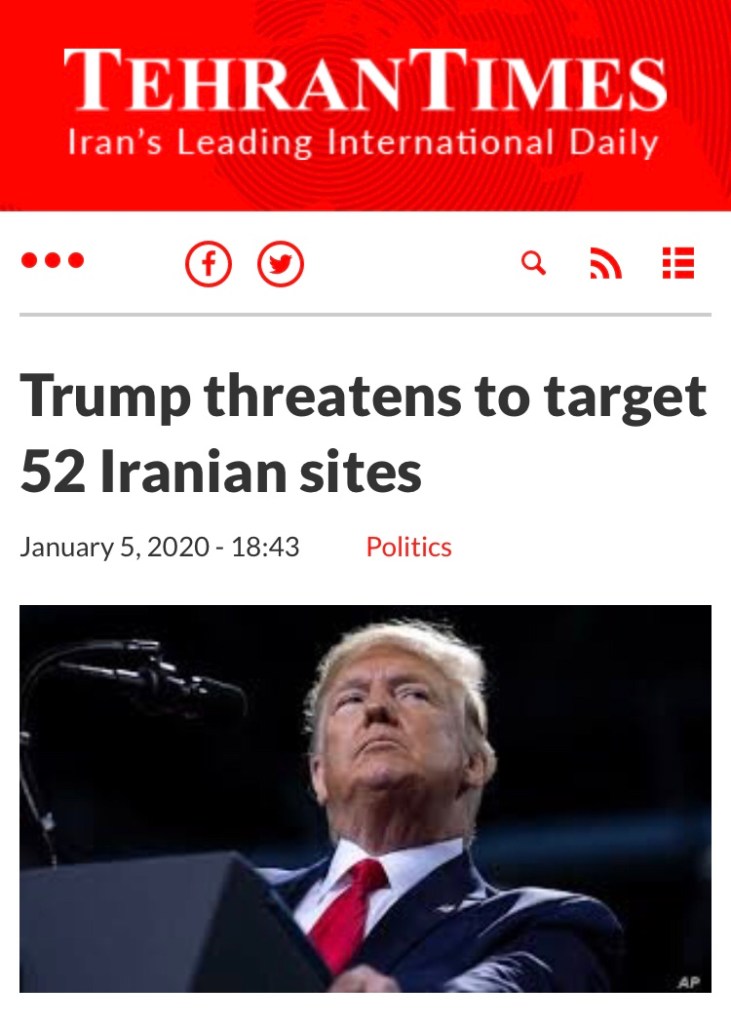
Coverage by Iranian source
Coverage by American source

It can be easily noticed how US coverage attempts to point fingers away from themselves by showcasing Iran as the “bad guy”. The opening remarks of Fox News were “Iran threatens […]”,including a photo of General Soleimani. (Fox News, January 3rd 2020). Similarly, Tehran times began by saying “Trump threatens […]”, accompanied by a photo of US president Donald Trump. (Tehran Times, January 5th 2020).

This is also what Herman and Chomsky described as establishment; each news source seems to stick to its local perspective. (Herman & Chomsky, 1988)

In relation to Moeller’s (1999) four habits, the American connection is clearly conveyed in the Fox News article, given that it truly does have a direct connection, nevertheless, it is still considered bias information.

Reference List

Trump threatens to target 52 Iranian sites. (2020, January 5th). Tehran Times. Retrieved from https://www.tehrantimes.com/

Iran threatens retaliation after Trump-ordered airstrike kills Iranian Gen. Soleimani; Dems want explanation. (2020, January 3rd). Fox News. Retrieved from https://www.foxnews.com/

Herman, E. S., & Chomsky, N. (1988). Manufacturing Consent: The Political Economy of the Mass Media. United States: Pantheon Books.

Moeller, S. (1999). Four Habits of International News Reporting. Waltham, Massachusetts, MA: Brandeis University.

Habits of American News Reporting in Palestine

According to Moeller (1999), there are four habits of International News Reporting: 

  1. Formulaic Coverage
  2. Sensationalized Language
  3. Analogies, Metaphors and Images 
  4. An American Connection

Moeller emphasized how global media has always been influenced by the US and is constantly attempting to make stories more relevant and striking for Americans. If that’s the way Internationals go by, one can only imagine what original American coverage must be like.  

An example would be the American coverage of the 2009 war in Gaza, Palestine, where the four habits mentioned are clearly applicable.

First, one cannot deny that American press is trying to shape a clear format for Palestinian news. While they claim to demonstrate Palestinians and “Israelis” as equals, it cannot be more obvious that they are trying to shove Israeli narrative down our throats.

Second, in this case, the use of language is somewhat tricky. Of course, US press will not dramatize the situation, because god forbid people empathize with the Palestinian people. For example, when referring to TV news programs, Battah (2009) remarks that the number of deaths is identified as the number of “people killed” instead of straight-up mentioning Palestinians.

Thirdly, even the images presented through their media somehow also favor the Israeli narrative, even when the story isn’t really about them.

The images of two women on the front page of an edition of The Washington Post last week illustrates how mainstream US media has been reporting Israel’s war on Gaza. On the left was a Palestinian mother who had lost five children. On the right was a nearly equally sized picture of an Israeli woman who was distressed by the fighting, according to the caption.

Battah, 2009

Reference List

Moeller, S. (1999). Four Habits of International News Reporting. Waltham, Massachusetts, MA: Brandeis University.

Battah, H. (January 2009). In the US, Gaza is a different war. Retrieved from https://www.aljazeera.com/focus/war_on_gaza/2009/01/20091585448204690.html

The Five News Filters

“A propaganda model focuses on this inequality of wealth and power and its multilevel effects on mass media interests and choices”.

Herman & Chomsky, 1988
  1. Ownership

Mass-media firms tend to target their content at elite audiences; otherwise, they just might get attacked! Let’s not forget that media companies require government licenses and franchises, which makes them prone to harassment by such sectors if their content appears to contradict or disagree with their capitalist principles. (Herman and Chomsky, 1988)

  1. Advertising

Advertisers have so much power over TV programming simply because they are paying for the programs. Corporate advertisement is somewhat selective with what programs to sponsor depending on the nature/ content of that program. Due to this, TV networks learnt that controversial programs lack support from sponsors and hence do not sell, so over time, light entertaining programs became more popular. (Herman and Chomsky, 1988)

  1. Source

Media companies usually obtain their news from trusted, credible sources. Since mass media always claim to be objective while delivering news, it’s important for them to have reliable. Powerful media sources manipulate the media to set a framework enforced with stories that favor certain sides as well as chase unwanted stories away from public eye. (Herman and Chomsky, 1988)

  1. Flak

Flak basically refers to any negative responses or attacks to media firm, whether it was through direct or indirect means. Because of flak, advertisers may withdraw their patronage, which negatively affects the financial status of the media corporation. As one might predict, governments are very common flak producers.

EXAMPLE

Egyptian satirist Bassem Youssef has been receiving all sorts of attacks by local powers. Youssef was faced with multiple lawsuits for insulting the president and Islam. In 2014, he was forced to flee the country. This pushed him to shut down his well-known show “El Bernameg”, and completely divert his content to air a program about the plant based diet, after five years obsent from television. (Maged, 2019)

  1. Common Enemy

Communism threatens the class superiority of many, for that reason, pro-communism content is widely fought against and is rarely featured in media programs. This also proves how media plays a big role in influencing viewers’ perceptions on concepts such as communism.

Reference List

Herman, E. S., & Chomsky, N. (1988). Manufacturing Consent: The Political Economy of the Mass Media. United States: Pantheon Books.

The Listening Post. (March 2017). Noam Chomsky – The 5 Filters of the Mass Media Machine.

Paget, S. (January 2018). Bassem Yousef: The Wild Story of ‘Egypt’s Jon Stewart’. Retrieved from http://www.bbc.com/culture/story/20180110-bassem-youssef-the-wild-story-of-egypts-jon-stewart

A troubling attack on Egypt’s media. (January 2013). Retrieved from https://www.thenational.ae/a-troubling-attack-on-egypt-s-media-1.257173

Maged, M. (March 2019). Bassem Youssef reveals BBC comeback after long absence. Retrieved from https://egyptindependent.com/bassem-youssef-reveals-bbc-comeback-after-long-absence/

Design a site like this with WordPress.com
Get started