Prison Radio as “Free Radio”

What Is Prison Radio?

It refers to radio programs which allow prisoners to express themselves to the general public, both inside and outside of prison. According to Anderson (2012), there are two types of prisoners’ radio programs:

  1. Those focused on prison issues,
  2. Those that play requests and dedications.

Platforms which broadcast such programs are usually regarded as part of the community broadcasting sector; they focus on community participation and seem to be more prepared to tackle prisoners’ issues. This also relates to Fanon’s idea of an “active community” (Fanon, 1994); in the sense that prisoners have a platform to contribute to their community’s media production.

In addition, Prisoners’ radio also highly relates to Dunifer’s (2010) concept of free radio, prisoners are given a chance to speak up against governmental brutality. All this empowers by making them feel more significant as individuals.

What I’ve found this program has created in me is a high level of respect and thankfulness for others who take the time out of their lives for my/others benefit, without judgement, and share enough of themselves to make those who participate and listen feel like someone.

(T.C. at Wolston Correctional Centre, Brisbane, 2007; emphasis added)

In conclusion, Andersen argues that taking part in radio production stimulates active citizenship, and this participation is a site of empowerment (Meadows et al., 2007, as cited by Anderson, 2012).

Reference List

Anderson, H. (2012). Facilitating Active Citizenship: Participating in Prisoners’ Radio. Routledge.

Fanon, F. (1994). A Dying Colonialism. Grove Press.

Dunifer, S. (2010). Latitudes of Rebellion: Free Radio in an International Context. In A. Langlois, R. Sakolsky, & M. V. D. Zon, (Eds.), Islands of Resistance: Pirate Radio in Canada. (pp. 23-32). New Star Books.
Resisting Colonialism Through the Radio

Voice of Algeria

At the time of the French colonialism in Algeria, there was a radio channel under the name Radio-Alger, which was owned by the French. Algerians refused to tune in and wanted to produce something original.

To fight against colonialism through the media, the Voice of Algeria emerged. It was something that was theirs; it reflected their heritage and sovereignty. (Fanon, 1994)

Free Radio

Free radio is an expression of immediacy and a rejection of state and corporate control. 

Dunifer, 2010.

Keep in mind that free radio is not anything like an NGO, as it does not operate under formal institutional laws. Free radio stations require no more validation than that given by their creators (Dunifer, 2010), which is why they cause harm, and hence resistance, against the governmental capitalist system.

Reference List

Fanon, F. (1994). A Dying Colonialism. Grove Press.

Dunifer, S. (2010). Latitudes of Rebellion: Free Radio in an International Context. In A. Langlois, R. Sakolsky, & M. V. D. Zon, (Eds.), Islands of Resistance: Pirate Radio in Canada. (pp. 23-32). New Star Books.

How do we protect ourselves from Facebook?

2. 4 Billion people, 2.4 Billion lives, multiply that number by thousands and you’ll get the amount of data Facebook has on you.

We are being watched 24/7 and it’s not just Facebook. Writing this very blog I will leave behind me a digital footprint, and data about me is being collected, because surveillance laws allow it.

The reason for Facebook being one of the most dangerous communications companies is the fact that it owns several other popular social media platforms such as Instagram and WhatsApp, which makes it “concentrated” (Khiabany, 2016). This means that whatever content we share on any of its owned platforms all feed into one main outlet.

Moreover, as a result of this mass-surveillance, it makes it easier for Facebook to identify its problematic users, and label them as activists. That’s why we might often find certain posts as “censored”. For example, after the assassination of Iran’s General Qassem Soleimani in January 2020, Iranians had a lot to share on Instagram, but many journalists and activists have reported account shutdowns and censorship from the application itself (Cockerell, 2020).

So, what are the possible measures to protect ourselves from Facebook?

According to NBC News (2018), here are some of the solutions to help decrease media concentration, and limit exploiting surveillance methods:

  1. “Breaking up Facebook”: Re-distributing ownership of the different platforms currently owned by Facebook alone
  2. “Data Protection as a Right”: Amending cyber laws such that the government cannot use our data without us granting permission.

In my opinion, one must also try to maintain as much privacy as possible by not sharing lots of details on social media, keeping away information, turning off location services and so on.

The harder it is for them to obtain your data, the safer you are.

Reference List

Khiabany, G. (2016). The Middle East. In Birkinbine B., Gomez R., & Wasko J. (Eds.), Global Media Giants (pp. 273 – 286). Routledge.

Cockerell I. (2020, January 10). Instagram shuts down Iranian accounts after Soleimani’s death: News agencies, human rights activists and influencers have had their accounts deactivated.

NBC News. (2018, March 27). There Is No Way To Fix Facebook. So How Do We Protect Ourselves From It? | Think | NBC News [Video]. Youtube. https://www.youtube.com/watch?v=yIbTGT-U1aQ

My Digital Shadow

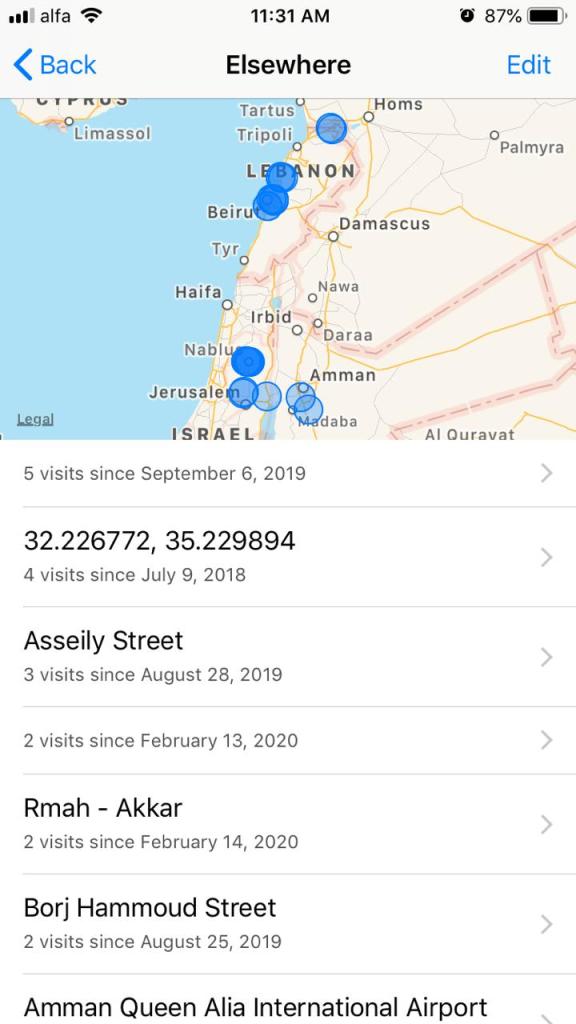
Through this exercise, I have noticed that my iPhone has kept track of every location I’ve been to since I bought my device, which makes me feel really scared and unsafe.

I was shocked to notice how Palestinian land is referred to by Apple as “Elsewhere“, as if it is not recognized. Other Locations in other countries are named street by street, but for some reason, streets of the west bank are only identified as numbers.

How PEM Shapes TV Programming in Lebanon

After carefully studying Majzoub’s 2015 documentary film, Fallen Television (تلفزيون وائع), the role of Political Economy of the media (PEM) in Lebanon has become clearer than we already suspected.

Unfortunately, in recent years, media has not only been advertising commodities, but has also been commodified itself, which Fuchs (2016) refers to as capitalist communications. According to Majzoub (2015), the Lebanese media companies are being treated like normal businesses, keeping “exchange value” (Fuchs, 2016) and profit as a primary goal.

Moreover, the most common method for shaping Lebanon’s media through political economy is Ownership (Fuchs, 2016). While sectarianism has been taking over Lebanon for as long as we can remember, it is no surprise to discover that almost every Lebanese TV channel is owned by a particular party/ politician, and only serves to support that party’s beliefs (Majzoub, 2015).

In addition, Lebanese media tends to be tremendously impacted by Western media. This has to do with the fact that the very owners of the TV channels are those who fit a certain higher social class, and their content was made to match elite’s expectation (Khiabany, 2016). As a result, when satellites were emerging in the region, many Lebanese channels aired French and English shows, while the content of those shows did not necessarily reflect Lebanese reality.

Furthermore, Lebanese media also underwent “Privatization” (Khiabany, 2016). Initially, the first Lebanese TV station was state-owned then it got partially privatized as Rafiq Al-Harari bought the private share. Nowadays it’s very rare to find public TV channels that allow secular, free forms of expression.

Reference List

Majzoub, M. (Creator). (2015). Fallen Television [Documentary Film]. American University of Beirut Media Studios.

Fuchs, C. (2016). Reading Marx in the Information Age: A Media and Communication Studies Perspective on Capital Volume 1. Taylor & Francis.

Khiabany, G. (2016). The Middle East. In Birkinbine B., Gomez R., & Wasko J. (Eds.), Global Media Giants (pp. 273 – 286). Routledge.

Facebook & “Surveillance Towers” in Palestine

Forms of Facebook Surveillance

According to Vaidhyanathan (2018), Facebook utilizes three forms of surveillance:

1.Commercial surveillance

Facebook uses personal information to match advertisements with user interest.

2.Peer Surveillance

Facebook users can watch and track each other, and in some cases might lead to harassment and shaming.

3.State Surveillance

“Governments use Facebook to spy on citizens or anyone they consider suspicious […]” (Vaidhyanathan, 2018, p.2).

“Surveillance Towers” in Palestine

The results of a study conducted by Shahrazad Odeh in 2018 show that many Palestinian women cannot fully and freely express themselves on social media platforms, and this is mainly due to a phenomenon they experience called the “surveillance tower”.

The Israeli occupation restrict freedom of movement, expression of opinion and choice of different and safe spaces for self-expression. It also reinforces existing social structures, and limits the paths of change and growth within the community, thereby increasing the nexus of violence within the society for ‘vulnerable’ individuals such as women, transgender people, and homosexuals.

Citation by Odeh (2018, pp. 12)

Therefore, we can imagine the forms of surveillance practiced by Israeli forces to oppress Palestinians, and Palestinian women are no exception.

In addition, Palestinian women experience discomfort when having family members on Facebook/other social media platforms. This especially applies to males such as fathers, uncles, and cousins, who are using it as a way to practice their patriarchal beliefs and to “watch over” the girls. As a result, the Palestinian woman’s freedom of expression on social media is limited by what may affect her family’s reputation. Although usually the intention is to protect women from virtual harm/ violence, but “there is a fine line between supervision and surveillance” (Odeh, 2018, pp. 18).

Reference List

Vaidhyanathan, S. (2018, August 18). Anti Social Media: How Facebook Disconnects Us and Undermines Democracy. Indian Cultural Forum. Retrieved from: https://archive.indianculturalforum.in/2018/08/18/anti-social-media-how-facebook-disconnects-us-and-undermines-democracy/

Odeh, S. (2018). A VIOLENT NETWORK: Gender-Based Violence Against Palestinian Women in Virtual Space. (A. Carmel, Ed.). Kvinna till Kvinna in cooperation with 7amleh.

Media Surveillance

What is the Surveillance-industrial Complex?

According to Ball & Snider (2013), surveillance is a combination of ‘socio-technical means through which jurisdiction interacts with social relations of commodity production.’

The surveillance-industry complex emerged from military and corporate institutions, and has been has been shaped by their capitalist mechanisms (Ball & Snider 2013). In other words, governments and other institutions are taking advantage of surveillance programs to gain more profit.

Why is Surveillance Important?

https://www.ritimo.org/Privacy-Surveillance-and-Data-Tracking-Why-Does-it-Matter-for-Human-Rights

[…] centralization, commercialization and datafication trends have also made it easier for governments and companies to engage in surveillance activities aimed at controlling, censoring and tracking down political dissents and HRD.

Hache & Jansen, 2018

*HRD: Human Rights Defender.

Reference List

Ball, K., & Snider, L. (Eds.). (2013). “The surveillance-industrial complex: towards a political economy of surveillance?”. (pp 1-5). Routledge.

Hache, A., & Jansen, F. (2018, July 9). “Privacy, Surveillance and Data Tracking: Why Does it Matter for Human Rights Defenders?”. Ritimo. Retrieved from https://www.ritimo.org/Privacy-Surveillance-and-Data-Tracking-Why-Does-it-Matter-for-Human-Rights

Media in the Middle East & Militainment

Arab Media Ownership

After the political events in the region which took place in 2008 and 2011, the middle east experienced a “media explosion” (Khiabany, 2016).

The explosion of Arab media into the scene was heralded as the clearest indication of forces of globalization, renewed faith in the role of media in social change, and prospect of democratization.

Khiabany, 2016

And according to Khiabany (2016), there are two primary links between the Middle East and the rest of the global community (specifically the US) i.e. oil/gas resources and Israel. Therefore, it is not surprising to know how big of a role Herman and Chomsky’s first filter plays: Ownership.

In one way or another, all media companies that have made it in the industry are owned or supported by Saudi Arabian figures, with Al-Jazeera being the only exception. The Saudi’s control over media companies in the region is strongly related to foreign relations with the US, which means their content must take into account this aspect.

EXAMPLE

Network: Spacetoon

Owner: Dr. Shihab Jamjoom

While Spacetoon is a cartoon network most Arab children grew up watching, it is sad to acknowledge that it is no different than other Arab media companies. The owner is based in Saudi Arabia and is in fact the deputy minister of Information in Saudi Arabia (LinkdIn, n.d.), meaning he must abide by governmental restrictions. Therefore, there must be restrictions on content in terms of broadcasting daring and contemporary shows for kids.

Militainment

Militainment is basically when military meets entertainment. As Andersen & Mirrlee (2014) described it, war and the “media war” are two different things.

War itself refers to actual material referents: invasions, occupations, violent conflicts and coups, and the cities, deserts and jungles where people fight, bleed, kill and die. Media images, tropes, themes and myths of war often bear little resemblance to war itself.

Andersen & Mirrlee (2014)

Reference List

Khiabany, G. (2016). The Middle East. In Birkinbine B., Gomez R., & Wasko J. (Eds.), Global Media Giants (pp. 273 – 286). Routledge.

Andersen R., & Mirrlees, T. (2014). Introduction: Media, Technology, and the Culture of Militarism: Watching, Playing and Resisting the War Society. Democratic Communique Vol 26 No 2.

Capitalism in Media & Communications

What Is Capitalism?

A system which promotes industries for the primary aim of making profit, which eventually continues to feed into that system.

“Capitalist Communications”

There are two angles to study the media’s contribution to capitalism. First, let us not forget how capitalist ideologies spread in the first place. As Artz (2008) put it, ” there is a certain magic in the way citizens have been transformed into consumers”, and that “magic” would certainly be the media.

Second, other than media platforms spreading ideologies, many communication initiatives are “organised as for-profit businesses.” (Fuchs, 2016).

In simpler words, “Capitalist Communications” is the communications industry’s reinforcement of capitalist ideologies, and involvement within the pro-profit system itself.

Reference List

Artz, L. (2008). Media Relations and Media Product: Audience Commodity. Democratic Communiqué 22, No. 1, Spring.

Fuchs, C. (2016). Reading Marx in the Information Age: A Media and Communication Studies Perspective on Capital Volume 1. Taylor & Francis

Design a site like this with WordPress.com
Get started