Final Reflections
Who would have thought we’d make it this far this fast?
That was how I began my first blog post with regards to the ever-evolving technology, but it also remains applicable to the journey we’ve made in this course. It’s no exaggeration to say that the concepts I’ve learned here helped me grow as a person, more aware of the social, political, and economical structures around me. I then realized that in the end, it all goes back to the mother of all concepts: Media Literacy.
After revisiting my first definition of the term, I found it best to reconstruct it as follows: Media literacy is the ability to understand, analyze, critique and produce images, words, and sounds, and share them via a medium.
My interest in the TV and film industry has never been stronger; I have now developed a much deeper understanding of the social impacts of this form of media which I plan on pursuing. Not to mention, this course taught me about the corrupt, capitalist and bias structures within the system, and provided me with the tools to fight against them once I hopefully make my way into that system.
This course has empowered me to speak up and take part in activist media, address the issues that deeply concern me, support alternative journalism, expose the gaps in the system, and suggest improvements.
It makes me happy to think of how many students before me have taken this course, of how the rising generations are actually becoming media literate. It gives me hope that it’s not too late to save the media.
It’s been good dear blog 🙂
Class Exercise 7 & 8
Class Exercise 5&6
Killing Gaza – Reflection
How is this film an example of witnessing vs bearing witness? What examples can you note of proactive and accidental witnessing?
Based on the 16 minute clip assigned, I could tell that Killing Gaza (Blumenthal, 2018) is an example of bearing witness; the filmmaker clearly traveled to Gaza with the intention of documenting human rights violation (Ristovska, 2016) to show audiences Israeli brutality. However, the film also exhibits witnessing in the sense that it does not strongly emphasize the need to take new measures -it is simply documenting/ shedding the light (Ristovska, 2016).
Nevertheless, we can say that most of the film exhibited proactive witnessing. However, the death of the young boy on camera was completely accidental; the film crew were following the boy to search for his family members under some ruins, but their search was interrupted by an Israeli attack which led to the boy being martyred (Blumenthal, 2018).
How does this film use testimony for moral engagement?
It is needless to say that the Palestinians’ testimonies were the heart if the film. The authenticity behind their pain, as they spoke about their destroyed homes, is was morally engages the audience.
What is the impact on the audience?
The answer is simple: the film is bound to make you cry. It is with no doubt that it triggers compassion. Since the filmmaker is American, the target audience could possibly be people with enough power to help make a change, which takes us back to how this film shows bearing witness.
Reference list
Blumenthal, M. (Director). (2018). Killing Gaza. [Documentary Film].
Ristovska, S. (2016). Strategic witnessing in an age of video activism. Media, Culture & Society, 38(7), 1034–1047.
Class Exercise 4 – Sound
| Sound | C/ R/ U | N/ H/ T | M? | Close/ Far |
| Birds chirping | C | N | M | Close |
| Cat | U | N | Far | |
| Motorcycle | R | T | M | Close |
| Car | R | T | M | Close |
| Dog bark | U | N | Far | |
| Kitchen utensils | R | H | Far | |
| Brakes | R | T | M | Close |
| Metal | R | H | Far | |
| Fly buzzing | U | N | M | Close |
| Pigeon cooing | R | N | Far | |
| Chatting | R | H | M | Far |
| Honk | R | T | Close | |
| Pen against paper | R | H | Close | |
| Cheering | U | H | Far | |
| Footsteps | R | H | M | Far |
| Motor engine | Became C | T | Close | |
| Cart rolling | U | H | M | Far |
- The sounds which were inaudible in the recording were the really faint/ far ones i.e. the pen sliding against the paper and some faint cheering from the neighbors.
- New Sounds: The nature of the sounds I just heard wasn’t that exceptional, so I guess I can’t consider it new sound. However, back home, I wouldn’t have heard birds continuously chirping, and I wouldn’t have heard the neighbors’ lunch plates clattering because buildings in Amman are further apart from buildings in Beirut. Perhaps in my parents childhood, they didn’t hear much car brakes or motorcycles.
- Old Sounds: living in a new city, I no longer hear the sound of the cotton candy man’s whistle as he rolls down my street, or the cheaply remade Beethoven symphony being transmitted by the gas cylinder truck.
- 2 minutes of the recording with most sound: 04:10 – 06:10
Example of Fake News
Rumor: American congress commences session with verses from the holy Quran out of fear from the Coronavirus. (Rasd News, 2020)
Truth: A three year old video showing President Donald Trump attending a session to support religious diversities in the Washington National Cathedral -an official tradition implemented by a president when taking up the reins of government. (Al-Assaf, 2020)
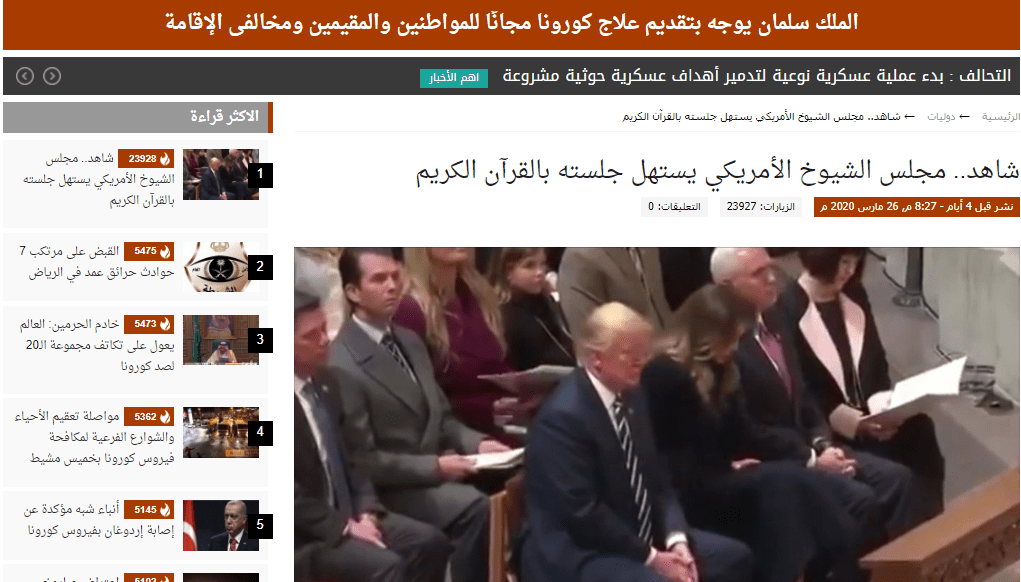
In terms of Steinberg’s (2017) types of fake news, this example would fall under the tenth and last type: Bogus. It is so obviously fabricated and can be referred to as disinformation or hoax. The motives were most likely religious and political; the paper is licensed by the Saudi Arabian ministry of culture (Rasd News, n.d.) and media and its writers seem to be very much pro-KSA. Even if you study the name of the article found within the same screenshot above, it praises King Suliman for offering a cure for COVID-19 for free for citizens, residents, and illegal residents.
Fortunately, reactions made towards this news piece and the associated video were mostly calling it out for being false, unrelated to the Coronavirus, and old footage. This proves that people are aware of the phenomenon of fake news and are educated enough to be critically thinkers. However, one cannot deny that some people might still be fooled; there are 23968 views on the article, more than 200 likes and 180 retweets on a tweet (Al-Senani, 2020) sharing the same information, chances are some people fell for it, and even shared it among others!
So, how can we help stop the phenomenon of “fake news”? Ministries of Media must revisit their policies (Kumanyika, 2018) and be selective when it comes to licensing media platforms, because they will eventually be caught and reported. In the case of Saudi Arabia, citizens must be aware that not every news piece which reinforces Islamic ideologies and goes in line with their beliefs is in fact true.
Reference List
Al-Assaf, L. (2020, March). مرصد الدستور يفنّد تسجيلات صوتية و فيديوهات متداولة. Addustour.
Al-Senani, M. [@MusaadAlSenani]. (2020, March 26).مجلس الشيوخ الامريكي بحضور الرئيس #ترمب يفتتحون جلستهم بالقرآن الكريم. [Tweet]. Twitter. https://twitter.com/MusaadAlSenani/status/1243218785391255552
Kumanyika, C. (2018, November 9). Beyond Fake News [Conference Session] Rutgers University. Retrieved from https://www.youtube.com/watch?v=t10ErbfwG14&feature=youtu.be&t=2925
Rasd News, (2020, March 26). شاهد.. مجلس الشيوخ الأمريكي يستهل جلسته بالقرآن الكريم. Rasd News. Retrieved from https://rasdnews.net/266548/
Rasd News, (n.d). الرئيسية. Rasd News. Retrieved from http://rasdnews.net/
Steinberg, L. (2017, July 26). Infographic: Beyond Fake News – 10 Types of Misleading News – Sixteen Languages. eavi Media Litercay for Citizenship. Eavi Media Literacy for Citizenship. Retrieved from https://eavi.eu/beyond-fake-news-10-types-misleading-info/
E-guerilla Tactics & Palestinian Cyber-Activists
E-Guerilla Tactics
- Creating an international network of information sharing.
- Formulating a chat forum between the urban revolutionaries and EZLN for decision-making.
- Translating communiques into various languages in the chat rooms to discuss the well being of the Zapatistas.
“Cross-cultural dialogical praxis was the EZLN’s most powerful strategy of resistance, unification, and survival.
Ford & Gil as cited by Padgett, 2017
Palestinian Cyber-Activists
Structural Constraints
Structure of settler colonialism – global capitalist structure – economic and territorial structures – power structures.
PA Forces
- PA forces under President Mahmoud Abbas and Hamas officials in Gaza have curbed what they deem subversive online politics, claiming that expressions of opposition to the occupation are benign and imply mocking the president.
- Activists described the PA as practicing “indigenous collaboration” and being a “subcontractor of occupation,”.
(Tawil-Souri & Aouragh, 2014)
Hamas-Fatah Division
- The division has had a demoralizing effect.
- Their infighting, curfews, closures, military incursions, or exile, all affected cyber-activists.
(Tawil-Souri & Aouragh, 2014)
- Facebook shut down some pages reported as inappropriate.
Engaging social media can be “empowering”, but online social networks offer activists less political agency as corporate algorithms and Facebook monopolism increasingly filter and define the digital world.
Tawil-Souri & Aouragh, 2014
- Political involvement on Facebook creates a form of engagement that is apolitical because one is inviting those already sharing the same argument. (Pariser as cited by Tawil-Souri & Aouragh, 2014)
(Tawil-Souri & Aouragh, 2014)
Other Real Frustrations
This engagement “creates a kind of self-rejoicing,”
Walid as cited by Tawil-Souri & Aouragh, 2014
It was just “online masturbation” that had become the goal rather than a tool
Ahmad as cited by Tawil-Souri & Aouragh, 2014
for organizing.
We can post YouTube clips of soldiers’ mistreatment [of Palestinians].
Mahir as cited by Tawil-Souri & Aouragh, 2014
Maybe some of the B’tselem videos [from Shooting Back] make a
small dent, maybe Burnat’s film [Five Broken Cameras] rallies a few
foreigners to the Palestinian cause. But these don’t stop the ongoing
violence of occupation!
Reference List
Padgett, R.(2017, February 25). Radical legacy of the Zapatista’s media strategy. SVLLY (wood). Retrieved from http://www.svllywood.com/intifadaessays/radicalmedia
Tawil-Souri, H., & Aouragh, M. (2014). Intifada 3.0? Cyber colonialism and Palestinian resistance. The Arab Studies Journal, 22(1), 102-133.
Independent Journalism in Jordan

Al-Hudood (The Limits) is an Arabic newspaper launched in 2013 by a group of young people in Jordan. The paper “uses satire to reveal serious and often dark realities about the world we live in” (Stuart, 2016), and can often be referred to as the middle-eastern equivalent of the Onion (Stuart, 2016; Shaheen, 2018).
Its content is available online through their website and social media accounts (with their Facebook page growing in popularity), or by subscribing to their printing service and have a hard-copy delivered to your doorstep -for free (Al-Hudood, n.d.).
Stuart (2016) himself refers to Al-Hudood as an “independent media outlet”, and the fact that it is registered as a non-profit organisation supports that idea (Forde, 2011). They also have a section called “voices from the streets” which features public opinions on different topics, or as Forde (2011) puts it: alternative perspectives.
Al-Hudood’s financial support comes from donations, subscriptions, and NGO’s (that are mostly European),with advertising being completely off the table. According to what founder Isam Uraiqat told MEE, “No one can think of advertising with us. It’s too dangerous,” (Stuart, 2016).
Being owned by a group of young Jordanians proves that there is no large media corporation involved. Moreover, Al-Hudood goes against corporate control by simply critiquing it through satire. All of this definitely matches a good number of Dunifer’s (2010) characteristics of “free media”.
Reference List
Al-Hudood. (n.d.). Al-Hudood [Website]. Retrieved from https://alhudood.net/
Stuart, H. (2016, August 3). Jordanian website turns to satire to combat heavy news. Middle East Eye [Website]. Retrieved from https://www.middleeasteye.net/features/jordanian-website-turns-satire-combat-heavy-news
Shaheen, K. (2018, February 9). Al-Hudood: the Onion-style website poking fun at the Middle East. The Guardian [Website]. Retrieved from https://www.theguardian.com/world/2018/feb/09/al-hudood-onion-style-website-poking-fun-middle-east-isam-uraiqat
Forde, S. (2011). Challenging the News: The Journalism of Alternative and Community Media. Palgrave.
Dunifer, S. (2010). Latitudes of Rebellion: Free Radio in an International Context. In A. Langlois, R. Sakolsky, & M. V. D. Zon, (Eds.), Islands of Resistance: Pirate Radio in Canada. (pp. 23-32). New Star Books.
Independent/ Alternative Media
In Forde’s study (2011) on alternative and independent journalism, she mentions that the terms independent and alternative may be used interchangeably to deliver the same meaning (which several theorists and media researchers still haven’t agreed on a single term to describe it).
How does this type of media differ from “mainstream” or conventional media?
At its core, alternative or independent media stands for “any type of communications which is not made by a recognized major media ownership groups.” (Forde, 2011, pp. 19). Platforms for alternative media are most likely to be non-profit and tend to focus on the idea of “active community” (Fanon, 1994; Anderson, 2012; Forde, 2011). For example, alternative media gives importance to the voices that aren’t normally represented in the media; the alternative journalists themselves or those featured in their media content need not be professional journalism practitioners, for they could simply be amateurs.
Reference List
Forde, S. (2011). Challenging the News: The Journalism of Alternative and Community Media. Palgrave.
Fanon, F. (1994). A Dying Colonialism. Grove Press.
Anderson, H. (2012). Facilitating Active Citizenship: Participating in Prisoners’ Radio. Routledge.
 Mira's Trail of Thoughts